
Innovation to Impact: What India's MedTech Ecosystem Can Learn from ICMR's Industry Connect Initiative
- Mobilab

- Jun 4
- 3 min read

India is witnessing a healthcare transformation driven by MedTech innovation, point-of-care diagnostics, digital health, and public-private partnerships (PPP). Yet, despite remarkable research and breakthrough healthcare technologies emerging from laboratories across the country, a critical question remains:
How do healthcare innovations reach the last mile?
This question took center stage at the recent ICMR "Innovators to Industry" event, where researchers, startups, manufacturers, healthcare providers, and policymakers came together to discuss one common goal: accelerating the journey from innovation to real-world healthcare impact.
As participants in the event, the Mobilab team witnessed a clear shift in India's healthcare narrative. The focus is no longer just on innovation; it is on commercialization, scalability, accessibility, and adoption.
India's Next Healthcare Revolution Will Be Built Through Collaboration
No single stakeholder can solve India's healthcare challenges alone.
Researchers develop breakthrough technologies. Startups build solutions. Industry manufactures at scale. Governments create enabling policies. Healthcare providers deliver care to patients.
When these stakeholders work together, innovation moves faster.
This is where Public-Private Partnerships (PPPs) become strategically important.
Whether it is expanding diagnostic access in rural India, strengthening primary healthcare infrastructure, or enabling affordable disease screening, PPP models are becoming the backbone of deploying healthcare innovations across the country.
For MedTech startups, collaboration is no longer optional—it is a growth strategy.
The Opportunity in Point-of-Care Diagnostics
One of the strongest themes emerging from industry discussions is the growing demand for point-of-care testing (POCT) and decentralized diagnostics.
India cannot rely solely on centralized laboratories to meet the diagnostic needs of a population exceeding 1.4 billion people.
Healthcare needs diagnostics that are
Portable
Affordable
Rapid
Accurate
Easy to deploy
Accessible in underserved regions
This is particularly important for primary health centers, rural clinics, mobile healthcare units, occupational health programs, CSR healthcare initiatives, and preventive screening campaigns.
Mobilab's Experience: Taking Diagnostics Closer to the Patient
At Primary Healthtech, this vision aligns directly with our mission.
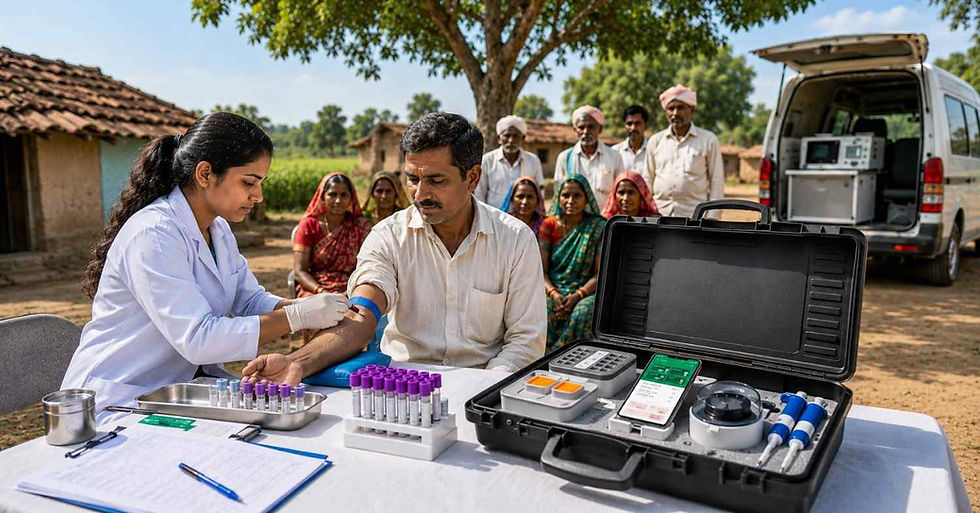
Through Mobilab - our portable, AI-enabled clinical chemistry analyzer—we are working towards making blood diagnostics more accessible by enabling multiple pathology parameters to be tested through a compact lab in a box, point-of-care diagnostic solution.
Instead of requiring patients to travel long distances or wait for centralized laboratory reports, healthcare providers can perform rapid diagnostic testing at the point of care with digital reports shared within 30 minutes.
The objective is simple:
Bring diagnostics closer to communities that need them the most.
This approach supports faster clinical decision-making, improves healthcare accessibility, and strengthens preventive healthcare delivery.
Building for Adoption, Not Just Innovation
Many healthcare innovations fail not because the technology is inadequate, but because they are not designed for large-scale adoption.
For MedTech startups, success depends on answering critical questions:
Is it affordable for healthcare providers?
Does it address a real healthcare challenge?
Can it integrate into existing healthcare systems?
Can it create measurable health outcomes?
The startups that succeed will be those that build for implementation, not just innovation.
Building an Atmanirbhar Healthcare Ecosystem
India's healthcare future will be shaped by indigenous innovation.
Government initiatives, research institutions, healthcare startups, and manufacturing partners are increasingly working together to reduce dependence on imported medical technologies while creating solutions tailored to India's healthcare needs.
The focus is shifting towards:
Made-in-India Medical Devices
Digital Health Integration
Primary Healthcare Strengthening
Affordable Diagnostic Technologies
Rural Healthcare Access
For companies like Mobilab, this represents a significant opportunity to contribute to a healthcare ecosystem that is innovative, self-reliant, and patient-centric.
The Way Forward
The biggest takeaway from the ICMR Innovations to Industry Connect initiative was clear:
Innovation creates possibilities, but partnerships create impact.
The future of healthcare will not be determined by the number of technologies developed in laboratories. It will be determined by how effectively those technologies reach hospitals, clinics, primary healthcare centers, and patients.
As India's MedTech sector continues to grow, the organizations that combine innovation, scalability, affordability, and strategic partnerships will be the ones driving meaningful healthcare transformation.
For Mobilab, this journey has already begun, bringing portable, accessible, and affordable diagnostics closer to the communities and people that need them most.


Comments