
AI Diagnostics in Rural India: How Technology Is Transforming Healthcare
- Mobilab

- Jun 1
- 5 min read
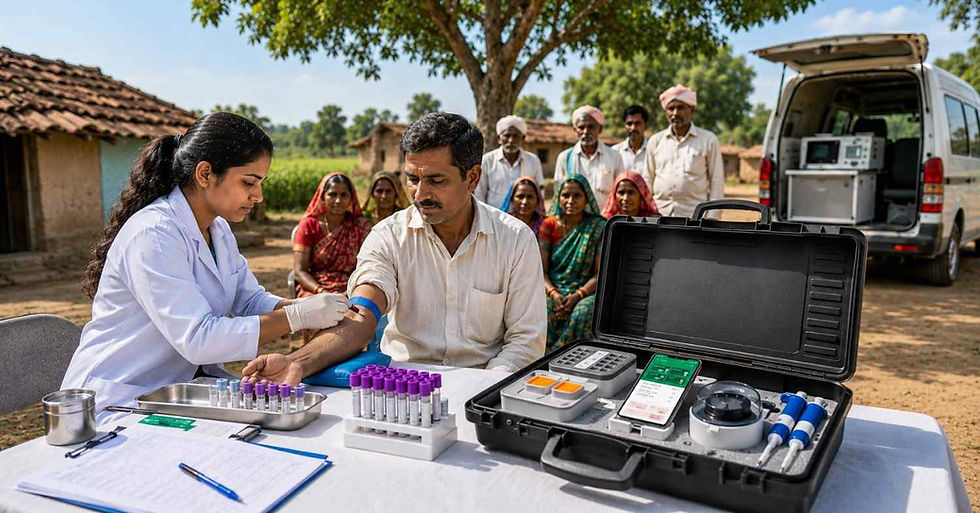
For millions of families living in India's villages, a simple blood test is rarely simple. The nearest diagnostic lab can be hours away, the reports can take days to arrive, and by the time a result reaches the doctor, the window for early treatment has often closed. This is the quiet crisis behind much of rural healthcare. The growing role of AI diagnostics in rural India is beginning to change that picture, bringing faster, more accurate testing closer to the people who have always had to travel the farthest for it. What once required a long journey to a city lab can now happen in a local clinic, sometimes within minutes.
Why Rural India Needs Better Diagnostic Access
The gap in rural diagnostics is not about awareness. It is about distance and infrastructure.
A patient in a remote village may live 40 or 50 kilometres from the nearest equipped laboratory. For a daily-wage worker, that journey means lost income, travel costs, and a full day gone.
Many primary health centres simply do not have the equipment or trained technicians to run routine blood tests on site. Samples are collected, then sent away.
The result is a delay that can stretch from days to weeks. For conditions like anaemia, diabetes, or infection, that delay can be the difference between a manageable problem and a serious one.
When diagnosis is slow, treatment is slow. And in healthcare, time lost is rarely recovered.
Q: Why is diagnostic access important in rural India?
A: Early diagnosis leads to faster treatment, better disease management, and improved healthcare outcomes.
What Are AI Diagnostics?
AI diagnostics use artificial intelligence to read and interpret medical data, helping healthcare workers reach reliable conclusions faster.
Instead of relying only on manual analysis, these systems learn from large volumes of clinical data. They can flag patterns, spot anomalies, and support a clinician's judgement with a second, data-driven opinion.
This matters most in places where specialist expertise is scarce. A trained technician may not always be available in a rural clinic, but an AI-supported system can help a health worker run and interpret a test with confidence.
The goal is not to replace doctors. It is to extend their reach.
Q: What are AI diagnostics?
A: AI diagnostics use artificial intelligence to analyze medical data and support healthcare professionals in identifying health conditions quickly and accurately.
How AI-Powered Diagnostics Are Transforming Rural Healthcare
The real value of AI in diagnostics shows up at the point of care, where the patient actually is.
Faster Testing
Point-of-care testing removes the wait. A blood sample can be processed on the spot, with results ready in minutes rather than days.
This means a patient who walks into a clinic in the morning can often walk out with answers, and a treatment plan, the same day.
Improved Accessibility
When testing no longer depends on a distant central lab, healthcare reaches further. Remote villages, small clinics, and health camps can all run tests locally.
Real-time reporting also lets results be shared digitally with doctors, supporting remote consultations and follow-up.
Better Clinical Decisions
With accurate data in hand quickly, clinicians can make sharper decisions. AI support reduces guesswork and helps prioritise patients who need urgent attention.
Less dependency on centralised labs means fewer bottlenecks and fewer patients lost to the system along the way.
Portable Diagnostics and the Future of Last-Mile Healthcare
Perhaps the most exciting shift is the move toward portable diagnostics that bring the entire lab to the patient.
The idea is straightforward: instead of sending samples to a lab, the lab travels to the community. A compact, portable platform can be carried into a village clinic, a corporate camp, or a relief setting and set up in minutes.
AI-powered portable diagnostic platforms are helping bridge the healthcare gap where traditional laboratory infrastructure is limited. Indian platforms like Mobilab, for example, are designed around exactly this need — bringing a full diagnostic lab to the patient rather than the other way around.
This model is well suited to community health camps and outreach programmes, where large numbers of people can be screened in a single day.
For rural and underserved populations, it removes the oldest barrier of all: distance.
The Impact of AI Diagnostics in India
The early signs of this shift are encouraging.
Faster healthcare delivery means problems are caught sooner, when they are easier and cheaper to treat. That alone changes outcomes for thousands of families.
There is also a strong preventive angle. Regular, accessible screening helps catch conditions before they become emergencies, supporting a healthier population overall.
This is part of a wider digital health transformation across the country. As more clinics adopt connected, AI-enabled tools, patient data becomes easier to track, share, and act on.
On the ground, this progress is already visible. Platforms like Mobilab have already supported lakhs of tests across regions spanning much of the country — a sign that portable, AI-driven diagnostics are moving from concept to everyday reality.
The direction of travel is clear: smarter, faster, and far more accessible healthcare.
Frequently Asked Questions
What is AI diagnostics?
AI diagnostics is the use of artificial intelligence to analyse medical data and help healthcare professionals identify health conditions quickly and accurately.
How accurate are AI diagnostic tools?
When properly validated, AI diagnostic tools can deliver accuracy comparable to central laboratory testing. Look for clinical assessment by recognised institutions such as ICMR and AIIMS Delhi — independent validation is what separates a clinical-grade platform from a promising prototype.
Can AI diagnostics work in rural areas?
Yes. Portable, AI-powered platforms are designed to run in clinics, camps, and remote settings where traditional labs are unavailable.
What is point-of-care testing?
Point-of-care testing means running a medical test at or near the patient, delivering results on the spot instead of sending samples to a distant lab.
Conclusion
AI diagnostics are quietly reshaping how healthcare reaches India's villages. By bringing testing closer to patients, they shorten the long wait that has held rural healthcare back for decades.
For communities that once travelled far for a single report, faster and more accurate testing is now within reach. Early diagnosis becomes possible, and with it, better outcomes.
As technology and portable diagnostics continue to mature, they will play a defining role in the future of healthcare delivery in India, one local clinic and one health camp at a time.
Building This Future, One Clinic at a Time
This shift toward accessible, AI-powered diagnostics is not a distant idea. It is already taking shape in clinics and health camps across the country.
Mobilab, a pioneering AI-powered portable diagnostic platform, was built around exactly the gap this blog describes — the long distance between a patient in a village and a reliable blood report. It runs a comprehensive menu of blood tests from a single venous sample, with results in about 30 minutes, wherever it is set up — in a clinic, a camp, or a remote village.
What gives a platform like this credibility is not the technology alone, but the institutions willing to stand behind it. ICMR and AIIMS Delhi came together specifically to assess and actively support Mobilab — a meaningful endorsement of homegrown healthtech. Independent validation across partners, including IIT Guwahati, GMCH, GNRC, and Nemcare, has consistently shown accuracy exceeding 92%.
The story of rural diagnostics is bigger than any one company — it is about closing a gap that has held communities back for decades. It is work worth doing together, and one Mobilab is proud to be part of.


Comments